Monday, October 1, 2018

Tips On Buying Your First Home

Buying your first home can seem pretty overwhelming at first. You search everywhere for the perfect location, saved your money and took the time to research. All that's left is to secure that mortgage! But how does the process start?

First, you will need a mortgage lender to issue you a mortgage pre-qualification form. From there the lender will ask you your gross (before tax) income is, what your monthly debts are (car payments, credit card minimums) and how much you have saved for your mortgage down payment and closing costs.

Remember, you are not looking to be approved quite yet just qualified.

The mortgage prequalification tells you that you should be able to afford a loan of X dollars and buy a home at X price. Although it is not an approval, it can save you a lot of time. One of the most important things mortgage pre-qualification tells you is what you can afford now. Pre-qualifications covers your income, assets, and debts. 

However, pre-qualification does not even involve a lender checking your credit or verifying your income.

Once you are prequalified for your home loan, the next step is easy. Complete a mortgage application with a local or online lender.

So do not be afraid to start the process of getting approved you can never be too prepared! Contact me today to begin the process!


Saturday, September 22, 2018

Why it may be better to buy a home in the fall

I am sure you have heard that the best time to buy a home is in the spring because there is an abundance of listings but many people are now saying that fall is when the real magic can happen and here is why.

High inventory of leftover homes from the summer are readily available. Come October sellers are ready for something to bite because their homes have been sitting on the market all summer.
Which then leads to another reason as to why the fall might be best.
Sellers are motivated to close by the end of the year. Everyone wants a fresh start come January 1st, so the sooner they can sell their home before the desire to start fresh at the beginning of the year, the better.

My third point then follows.

Fall landscaping is the best, I mean come on, beautiful changing of colors, cool weather, piles of bright, fresh smelling leaves. This is the perfect scene for staging and selling a home.

Next to landscaping, many families want to be in a new home before the start of school so that their children don't face too much of a disruption. Therefore, the competition is much lower in the fall to buy a home.

Fall begins the start of holiday season, you begin with Halloween and then comes Thanksgiving and before you know it Christmas is here and everyone is holding parties and having family over to celebrate. The last thing a seller wants or needs is a sale looming overhead.

Sure the spring is great, the flowers are blooming the birds are chirping but the fall truly may sneak up to the first place spot for buying a new home.

Thursday, July 26, 2018

Tips on the Appraisal Process For Homebuyers

Homebuying can be an overwhelming process with many crucial steps, which you are hopefully guided through by a great Mortgage Lender and Realtor on your side. One of the most important steps in buying a new home is to have an appraisal done to ensure that you are getting out of your future home what you’re putting in! Following these important steps can make getting your home appraised a breeze!


What All Buyers Need To Know About The Home Appraisal Process


Do you know what a home appraisal is, or why it’s so important for you to have? Many people misunderstand this crucial component of the home buying experience.

In a nutshell, an appraisal is a valuation of your home; it’s a way for lenders to ensure that they aren’t providing a mortgage that isn’t worth what the home is worth. Your appraisal must match or exceed the value of your loan, otherwise you’ll run into hiccups.

An appraiser is someone who uses comparable sales in your neighborhood as well as the condition of your home in order to make a sound valuation of your home. They’ll include factors both inside and outside the house.

If an appraisal is lower than the amount you thought the house was worth, there are several options, including renegotiating the deal and paying the difference. If it’s higher, it benefits the buyer. But knowing more about appraisals, whether you’re a homebuyer or seller, can help the whole process go more smoothly.


Article originally appeared on Lighter Side of Real Estate

Thursday, June 28, 2018

Rely on a Realtor's Recommendations?

Learning from the experience of others holds a lot of value, especially for first-time homebuyers. While consumers are more knowledgeable than ever about the housing market with blogs available (like this one), reading professional recommendations and ratings, or doing a little market recon before even picking up the phone, at some point they have to trust the professionals they’ve so dutifully researched.

Photo by Lukas from Pexels

While a mortgage lender will always argue that they need to be hired first, starting with a Realtor you trust can be a great move! They make it their business to know who does good business. A Realtor’s connections and recommendations will be properly vetted as reliable, friendly professionals and most importantly - get the job done.

There are plenty of skeptics out there who feel like using referred business lends way to some dubious profiteering. I’m glad to assure you that the Real Estate Procedures Act (RESPA), a piece of legislation designed to protect homebuyers, strictly prohibits kickbacks for referring mortgage lenders.

Realtors more than anything want your deal to go through and have a successful sale with happy customers, which is why they make recommendations based on their client’s needs. They’re familiar with lenders’ products and what might be a most successful path for their clients whether they are first-time buyers, renovators, investors, etc. Their recommendations are based on who they’ve worked with and who has the follow-through to make the deal happen.

Believe it or not, the rate isn’t the most important quality of a lender. Typically, many larger lenders remain competitive by offering similar rates, anyway. A Realtor doesn’t know rates, they know service and they’ve already weeded through the non-closers. Taking a .05% lower rate won’t mean anything if the lender fumbles at closing. So if you’ve already found a Realtor you trust, their recommendations for mortgage lenders are likely to be trustworthy professionals, too.

No matter who you hire first— a Realtor or a Mortgage Professional— getting pre-qualified (or at the very least, pre-approved) before home shopping is MUST!

Tuesday, May 8, 2018

How to work toward more home loan options

Photo by Andrii Nikolaienko from Pexels


There are many perspectives when it comes to how long getting a mortgage takes. Many articles read that it doesn’t take as long as you think, just one to three days! Some articles warn that it’s a many month process toward reaching the final goal. Having seen everything in-between, it can easily be said that you never know just how long it will take.

For buyers who have planned ahead, done any credit repair work that needed to be done (i.e. not zeroed out any self-employed tax returns for two years or saved for a downpayment) then the process will be smooth as silk! But truthfully, that is rarely the case. Many individuals don’t find out that this kind of effort is necessary until after their initial meeting with a loan officer.


The spring market is fast-paced and sometimes pre-qualification letters aren’t enough to out-compete another bidder. In a seller’s market, like the current Richmond market, many sellers won’t entertain offers without a pre-approval letter, meaning your credit and income have been verified. 

So if you missed out on this spring market, take the opportunity during the "slower" real estate months of summer to get your financial house in order and broaden your mortgage options.

Save money!
The larger your down payment, the wider your mortgage options.

Adjust your debt-to-income ratio
Get your credit card balances down as low as you can, or consider consolidating debts into one low monthly payment the bank know is achievable along with a mortgage payment.

Don't borrow any more money
Don’t buy a new car when applying for a loan. Don’t take out a loan on something else while applying for a loan. Don’t stretch your credit so thin that the bank questions your repayment ability, okay?

Student Loans won't stop you
“Almost 60 percent of first-time homebuyers said that student loans delayed their saving for a down payment” according to the National Association of Realtors. Having that debt is commonplace and won’t necessarily prevent you from getting a mortgage as long as you’ve managed it wisely.

Credit Repair
Many mortgage lenders are willing to give mortgages to individuals with a credit score of at least 620, depending on their financial history. If your credit is less than perfect, remember that it is only one part of a whole equation. However, if your score is in need of an overhaul here are some general credit rebuilding tips:
  • Look at your credit report for any past due accounts or late payments. If you have accounts, like a student loan payment, that is 90 days or more overdue, pay those off first. Accounts that are 60 to 30 days late will have a less negative impact than accounts that are 90 days or more late.
  • If your credit report is showing that an old bill is unpaid, you should not pay it unless you are able to pay it back in full. A partial payment may make the debt more relevant, which can hurt your credit score.
  • Lenders will see that you have been making an effort to pay off overdue accounts and reduce your existing debt. This will bring your credit score up and help improve your chances of qualifying for a mortgage. 


Resources: 


Monday, April 9, 2018

Homebuying Documents 101


The home buying process can be rife with complications and legalese for anyone who isn’t paying cash upfront, depending on your circumstances. For example, if you are trying to qualify for an FHA loan the home you’re buying needs to meet certain expectations and therefore could require multiple addenda. Or, if you are self-employed, there tends to be an extra burden of proof when it comes to showing the bank how much you make a year (deductions or business expenses can mean “less” take-home pay)!  There are certain extra steps the homebuyer needs to take in order to satisfy every institution involved in the homebuying process.

With that in mind, if your transaction isn’t as straightforward as you hoped, consult a professional who wants to make your experience as transparent as possible! Here are some of the main documents you’ll need throughout the home buying process:


Mortgage/Pre-Approval:
1. Tax Returns (at least one year, if self-employed or commission typically 2 years)
2. W2s (last 2 years)
3. Pay Stubs (last 2 years with year-to-date earnings)
4. Bank Statements (last 2 months)
5. Investment Account Statements
6. Copy of Your Driver's License or Photo ID
7. Credit Report

Submitting an Offer:
1. Copy of Your Pre-Approval Letter
2. Sales Contract (signed and dated)
3. Any Addendum

Closing:
1. Sales Contract (signed by Buyers and Sellers)
2. Title
3. Title Insurance
4. Copy of Your Driver's License or Photo ID
5. Deed
6. HUD-1 Statement
7. Survey
8. Proof of Home Insurance (if required by lender)
9. Proof of Required Repairs

10. Checks 


Thursday, March 8, 2018

Local Lenders Do It Best!

It’s that time of year again! The Spring Real Estate buzz has already started and it’s time to get busy on your pre-approval to be a competitive shopper in this low-inventory market!

By now you’ve probably been bombarded by pop-up ads and indiscriminate commercials on how to “simplify” your way to hundreds of thousands of dollars in mortgage loans. In an industry that now boasts mobile ready money, a personal touch can still make all the difference in getting to buy your dream home— or not.


Source: pixabay.com
Flexibility
The benefit of many local lenders is that they have a “people first” mentality when it comes to doing business. Often times applicants don't qualify right away if they are in need of credit repair or even need help proving income after having written off everything possible as self-employed tax filer. When you work with a local lender there are often programs, workshops, and in some cases, workarounds when it comes to getting you a great mortgage.

The reason many local lenders have flexibility over larger lenders and may even be able to approve applications rejected by conglomerates because their guidelines and criteria often differ. The bigger guys tend to sell their loans to Fannie Mae or Freddie Mac which also ties them to their strict guidelines. With a smaller lender there’s more opportunity for special financing and often the person receiving your application is has the final say in approving your loan.

A local lender's focus is on the community around them and helping local businesses and homebuyers qualify. Loan Officers have direct access to managers and a team of professionals that are excited about getting creative to help their clients.

Source: pixabay.com

Accountability
As a local lender, we meet with clients face to face every day. We are reminded that time really is money and closing on time is important. I’ve personally experienced working with a buyer who switched lenders for the promise of half a percentage point savings. After I had filed all the paperwork and submitted their pre-approval letter before the switch, the buyers didn’t let their agents know the financing on the deal had changed. When it came time to close, their new lender had done none of the paperwork to move the deal forward and they ended up not getting the house. The lender had no accountability or urgency for their closing date or sale. 

While this is a special circumstance, the fact remains that giant mortgage lenders deal with clients in bulk and meet their own deadlines— not yours. When it comes to accountability, that 24/7 customer service hotline only gets you so far.

Source: pixabay.com

Accessibility
Due to their volume, many national lenders simply treat their customers like a bottom line. While having an 800 number to call might be convenient, you never get the same person twice. Working with a local lender means they have a personal interest in your loan and in working with you to get the best option available. Many online reps follow prompts themselves to lead you toward a box-sized solution. Ultimately, they’re not mortgage lenders they’re tech support. 

Many larger banks brag about their around-the-clock service, however, I have yet to meet a dedicated mortgage professional that doesn’t pick up their phone on a weekend! Not to mention many local lenders have their own specialized apps and technology for easy access to your application and status updates.

Photo by picjumbo.com from Pexels 

Ultimately, If you have a standard W-2 based income at a job you’ve had for years, with no hiccups in your credit history, perhaps a mortgage app is a great tool for you. However, like most of us dealing with life; changing jobs, freelancing or self-employment, non-liquid assets, small business ownership, missing a payment here and there— it may be difficult to fill in all that information with two thumbs.


Don’t leave money on the table or wonder if you’re getting the best mortgage for you. Work with a local lender! 

Tuesday, February 6, 2018

3 Reasons Homeowners Should Itemize


While the new standard deduction has recently been increased by the Tax Cuts and Jobs Act ($12,000 and $24,000 for single filers and joint filers, respectively) if you qualify for these 3 tax breaks, it may still be worth it to itemize.


Mortgage Interest
Writing off the interest on a home loan from federal income tax is a major homebuying incentive. While the maximum deduction was capped at $750,000 on mortgage loans taken after December 15, 2017, that still leaves many Americans eligible to take advantage of the tax incentive.

However, did you also know that you can write off your points?  Points refer to one percent of your loan’s total value. While you can’t claim origination points, discount points— or those you pay upfront to reduce your rate—  are very much deductible.

Property Tax
Many major cities have high property taxes and a homeowner's ability to deduct them from
Federal Income tax is a relief to those who live in high property taxed areas. Take as much advantage of your property tax deduction this tax season because in 2018, these property taxes will be capped at $10,000.

If you just bought your home, don’t forget to include the taxes you paid toward the seller for reimbursement. These are the taxes the seller paid before you took ownership.  You can find this amount on your settlement sheet. http://intuit.me/2DOu0rz

Photo: Bernadette Gatsby on Unsplash


Home Equity Loans & Medical Home Improvement
The only way to deduct interest on future home equity loans is if the funds are used to significantly improve the value of your residence. Conversely, Medical Home Improvements are deductible to the extent that they don’t increase the value of your home.

An example from Fool.com:
“For example, if your house was worth $200,000 and adding an elevator cost you $80,000 but increased your home’s value to $250,000, then you could only deduct $30,000 of the expense.”  If it doesn’t change the value of your home, then you can deduct the entire amount. You can also deduct upkeep expenses for medical improvements in future years. 

Photo: LES CUNLIFFE/ISTOCK/THINKSTOCK

While the standard deduction has increased, in the case of being able to claim all of these deductions, itemizing may be your best bet!

Most Americans can still take advantage of the many homeowner incentivizing tax breaks this year and next. Be sure to talk to your local tax expert to make sure you’re getting the maximum allowable deduction!

Tuesday, November 28, 2017

FHFA Announces Maximum Conforming Loan Limits for 2018


(Press Release - click here to visit the original article)
Washington, D.C. – The Federal Housing Finance Agency (FHFA) today announced the maximum conforming loan limits for mortgages to be acquired by Fannie Mae and Freddie Mac in 2018. In most of the U.S., the 2018 maximum conforming loan limit for one-unit properties will be $453,100, an increase from $424,100 in 2017.  
Baseline limit
The Housing and Economic Recovery Act (HERA) requires that the baseline conforming loan limit be adjusted each year for Fannie Mae and Freddie Mac to reflect the change in the average U.S. home price.  Earlier today, FHFA published its third quarter 2017 House Price Index (HPI) report, which includes estimates for the increase in the average U.S. home value over the last four quarters.  According to FHFA's seasonally adjusted, expanded-data HPI, house prices increased 6.8 percent, on average, between the third quarters of 2016 and 2017.  Therefore, the baseline maximum conforming loan limit in 2018 will increase by the same percentage.  
High-cost area limits
For areas in which 115 percent of the local median home value exceeds the baseline conforming loan limit the maximum loan limit will be higher than the baseline loan limit.  HERA establishes the maximum loan limit in those areas as a multiple of the area median home value, while setting a "ceiling" on that limit of 150 percent of the baseline loan limit.  Median home values generally increased in high-cost areas in 2017, driving up the maximum loan limits in many areas.  The new ceiling loan limit for one-unit properties in most high-cost areas will be $679,650 — or 150 percent of $453,100.  
Special statutory provisions establish different loan limit calculations for Alaska, Hawaii, Guam, and the U.S. Virgin Islands.  In these areas, the baseline loan limit will be $679,650 for one-unit properties, but loan limits may be higher in some specific locations.
As a result of generally rising home values, the increase in the baseline loan limit, and the increase in the ceiling loan limit, the maximum conforming loan limit will be higher in 2018 in all but 71 counties or county equivalents in the U.S.   
Questions about the 2018 conforming loan limits can be addressed to LoanLimitQuestions@fhfa.gov.
  • For a list of the 2018 maximum loan limits for all counties and county-equivalent areas in the U.S. click here.  
  • For a map showing the 2018 maximum loan limits across the U.S. click here.   
  • For a detailed description of the methodology used to determine the maximum loan limits in accordance with HERA, click here
###
The Federal Housing Finance Agency regulates Fannie Mae, Freddie Mac and the 11 Federal Home Loan Banks. These government-sponsored enterprises provide more than $5.9 trillion in funding for the U.S. mortgage markets and financial institutions. Additional information is available at www.FHFA.gov, on Twitter @FHFAYouTube and LinkedIn.
Contacts:
Media: Stefanie Johnson (202) 649-3030 / Corinne Russell (202) 649-3032
Consumers: Consumer Communications or (202) 649-3811

Monday, November 6, 2017

The Top 4 Reasons Why A Loan Doesn't Go Through


1. Credit Scores
This is probably the scariest and most common reason why people's applications won't go through - but this is exactly WHY you should talk to a Loan Officer early in the process, they can set you in the right path in case you don't have a perfect credit score. Also, there are products that only need a mid 600 score which a lot of people don't know. The sooner that you address this problem, the sooner that you can fix it and move on with the process of buying a home. 

2. Debt to Income Ratio
This is something that can be a little hard to understand but basically if you have too much credit card debt or maybe an auto payment that is high compared to the amount of income you earn every month, you may not qualify for the amount that you'd like. Yes, you may still qualify but knowing how much you qualify for is important when shopping for a home. Speak to a L.O. before you start home shopping and figure out what you can afford. 

3. Cash Due at Signing
Depending on the type of loan that you get, you may be required to bring a lump sum of cash to closing. There are programs that allow you to bring 1-3% and then there's other programs that require 20%. The more you put down, the lower the interest and the shorter loan you can get. Either way, it's important to have some money set aside for closings costs and unexpected expenses. 

4. Change in Employment / Financial Responsibilities
If you lose your job while applying for a home loan or if you buy a car or open a credit card while in the process of getting a loan might affect your chances of getting one. This can also be a factor even if you decrease the number of hours that you're working. For example if you were working full time and then end up working part time or maybe you're just not working enough hours. These are all different scenarios that could prevent your application from getting approved in the end. 

This list is a short one, but it covers some of the basic things you want to fix to avoid doing when you apply for a home loan. Even though some of these circumstances are unexpected, some can prevented or you can prepare for them. If you have any questions about any of this, please make sure to give me a call so we can get you straight for when you decide to apply! 


Wednesday, October 11, 2017

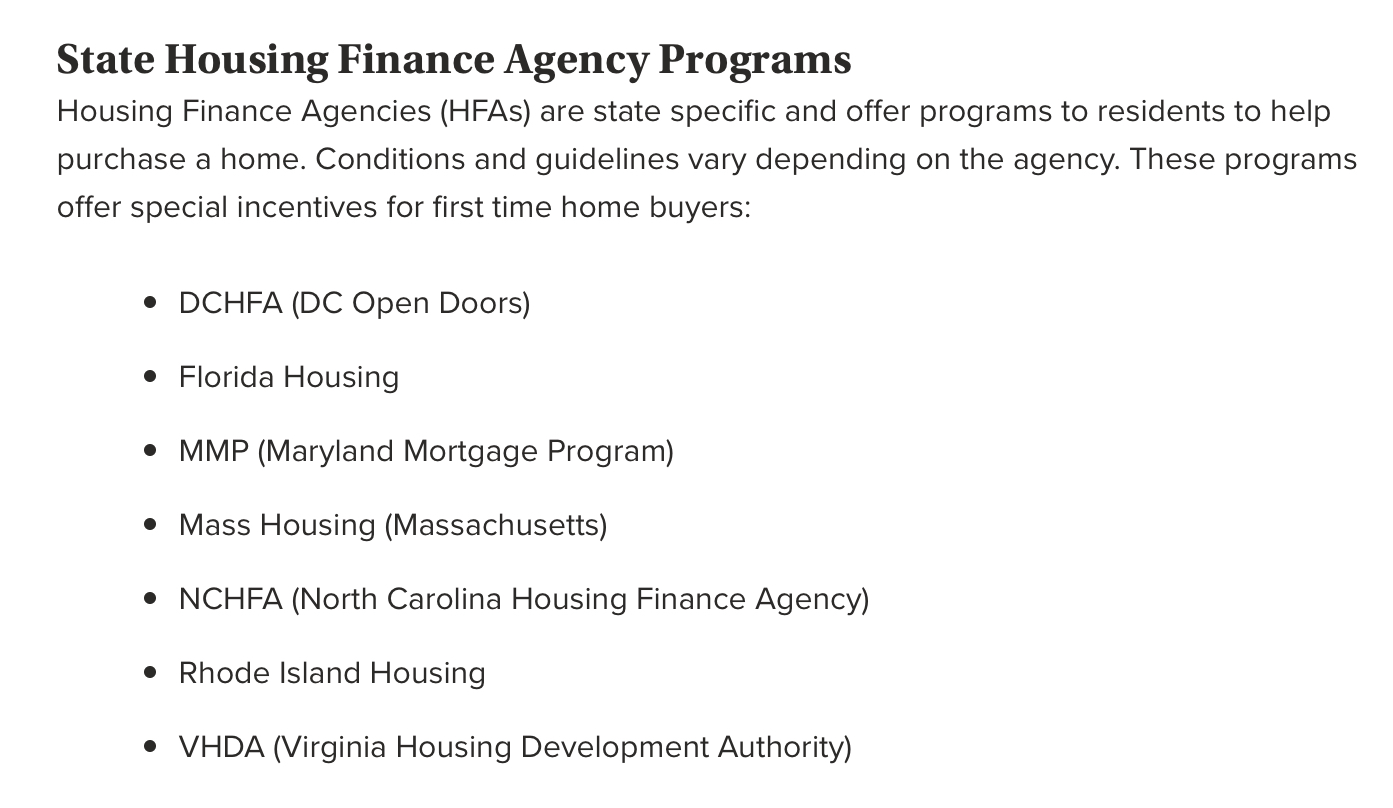
State Housing Finance Agency Programs


How can you make owning a home a reality? You know, a lot of people that I talk to everyday don’t realize that homeownership could be a reality for them. Why? Finances. Most people stress out about money and that they don’t have enough of it to buy a home. What’s so amazing about homeownership is that in some cases, your bills will stay about the same as if you were renting and in some cases, they may be lower! That’s pretty insane right? But it’s true, depending on what type of home you decide to purchase, your mortgage payment could be lower than your current rent. 

So how do we get you in a home without having a big downpayment? There’s quite a few State Housing Finance Agency programs which can help with not only the downpayment but with some of the closing costs too. Yes, you will have to bring some money to the table but it could be much lower than what you think! And if for whatever reason this isn’t an immediate goal for you, it’s important to meet with a Loan Officer to help you establish goals and checkpoints in order to get your finances in order and eventually become a homeowner. 

If you ever want to learn more information about what kind of assistance programs are available to you, make sure to give me a call! I’d love to speak with you about it. 

Monday, August 28, 2017

How to Get Rid of Private Mortgage Insurance


08/28/2017 12:52 pm ET
By Marilyn Lewis
You can find the original article by clicking here

If you have private mortgage insurance, you’re probably looking forward to the day when it ends, sweetly reducing your mortgage payment. Here’s good news: While PMI eventually is canceled automatically, there are several things you can do to make that day arrive faster.

You pay for PMI, but it protects your lender, not you, against the risk that you’ll stop making your mortgage payments. You aren’t the only one paying for it; about 13% of all mortgages in the U.S. have PMI. On average, homeowners with PMI make payments for 5 1/2 years before the insurance ends, according to U.S. Mortgage Insurers, a Washington D.C.-based industry group.

PMI is the only type of lender protection that you can escape. Department of Veterans Affairs mortgage funding fees can’t be canceled. Neither can Federal Housing Administration mortgage insurance premiums, which are paid to the government. Lender-paid mortgage insurance is paid in full when the loan is issued, and the borrower repays it through a higher interest rate. With all of those, you must sell or refinance to get clear.

Homeowners with PMI have six options for getting rid of it.

1. Wait for automatic cancellation

You don’t have to do a thing. Eventually, your mortgage insurance will fall away. Your lender is required to cancel your PMI when either of these things happens:

Your mortgage reaches 78% loan to value. The federal Homeowners Protection Act of 1998 requires lenders to terminate PMI, free of charge, at that loan to value ratio. To find your LTV, divide the loan balance by the original purchase price or calculate it here. For example, with a balance of $250,000 and a purchase price of $320,000, the LTV is 0.78, or 78%.)
The mortgage hits the halfway point. Regardless of your LTV, your lender terminates your PMI automatically when the mortgage is halfway finished — in year 15 of a 30-year mortgage, for instance. That could happen before the lender’s equity reaches 78% if your mortgage has a balloon payment, an interest-only period or principal forbearance.
Lindsey Johnson, executive director of U.S. Mortgage Insurers, an industry group representing large insurers, tells borrowers to request a written copy of their PMI cancellation schedule and their lender’s requirements. Call the number on your monthly mortgage statement and do it now, she says, long before you need it. That way you’ll know when your payments are supposed to stop and can watch your progress.

2. Request early cancellation

You can save money by acting to remove PMI sooner. “When your mortgage balance reaches 80% of your home’s original value — the lesser of the sales price or the appraised price at origination — your mortgage servicer must cancel [PMI] at your written request,” says Marc Zinner, vice president of commercial operations at Genworth, one of the largest private mortgage insurance companies.

Use your PMI schedule, which is based on your home’s original value, to track your progress. Make a written request to your lender several months before the mortgage is scheduled to hit 80% loan to value and get the process moving.

To make the case for early cancellation you’ll also need:

A good payment history. The rule is no payments 30 days late in the past 12 months and no 60-day late payments in the previous 24 months. Timely payments count when it comes to getting rid of PMI. Late payments can put you in a high-risk category, making it harder to cancel.
No other liens. Your mortgage must be the home’s only debt, including second mortgages, home equity loans and lines of credit.
Proof of value. An appraisal, at your expense, to prove the home’s value hasn’t fallen. Certain lenders accept a broker price opinion instead.
The Morning Email
Wake up to the day's most important news.

3. Get a new appraisal

If property values are rising where you live, you can request early cancellation based on the home’s current value. You’ll probably need a new appraisal for that.

Before spending $300 to $500 on an appraiser, check your lender’s rules. Some lenders require borrowers to use certain appraisers. Others accept a broker price opinion, a quicker process costing about half or less of an appraiser’s fee.

Here’s a caveat: To cancel based on current value, you must have owned the home for at least two years and have 75% LTV. If you’ve owned the home for at least five years, you can cancel at 80% LTV.

4. Boost value with home improvements

Depending on your market, you may be able to boost your home’s value with a well-chosen remodeling project. Remodeling Magazine says projects that enhance curb appeal, like upgraded siding, doors and windows, add the most value for the money spent.

5. Refinance your mortgage

Refinancing might also let you escape PMI, but make sure the premium payments you avoid are greater than your refinancing costs (use this calculator to decide).

6. Sell your home

The last resort when it comes to ditching PMI is to sell the home. It’s unlikely you’ll want to or need to, however, given the range of other choices.

Know your rights

Occasionally, borrowers and lenders knock heads over canceling PMI. If you run into insurmountable obstacles when trying to cancel, complain to the Consumer Financial Protection Bureau at 855-411-CFPB (2372).

Ray Rodriguez, a regional sales manager for Cherry Hill, N.J.-based TD Bank, says lenders vary in how they work with borrowers over canceling PMI. Think about mortgage insurance when getting a mortgage, he says. Tell the lender you need a copy of the loan’s PMI cancellation policies before you’ll sign the mortgage agreement.

“It’s the lender or whoever is going to service this loan who will make the rules on this,” Rodriguez says. “Your lender should know their servicing policy right upfront. If they say ‘No’ or ‘If’ or ‘Maybe’ and you call two other lenders and they say, ‘Absolutely, we would do that for you,’ you can vote with your feet.”

Marilyn is a personal finance writer at NerdWallet, specializing in mortgages and homeownership.

Friday, August 18, 2017

Special Announcement: VHDA Maximum Income Limits Update

From the VHDA:


"We are pleased to announce new VHDA maximum income limits will become effective with new applications beginning September 1, 2017.

Although most area limits increased, the Charlottesville MSA limits are slightly lower. This is due to in a reduction in the published HUD area median incomes for the Charlottesville MSA.

Standard program limits apply to all loan programs (FHA/FHA Plus/VA/RD/Fannie Mae) and MCC’s.

Lower income limits apply to the VHDA Grant Program.

Income limits have also increased for the FHA Streamline Refi and VA Interest Rate Reduction loan programs. These limits are available in the FHA Streamline Refi and VA IRRRL program guidelines.

A chart with the new limits is attached.

VHDA’s website will be updated September 1, 2017 to reflect the new limits."


Monday, July 31, 2017

Pro's, and Con's, of Buying New Construction


If you’ve been shopping the Richmond Real Estate Market you’ve probably find yourself a little frustrated. There is a higher demand for housing than there are houses themselves. This is due to a number of things: there is a growing job market, people from surrouding metropolitan areas are moving to Richmond, the cost of living is reasonable and it is centrally located in Virginia. This makes Richmond an attractive place for people to move to. Fortunately, builders throughout Central Virginia have taken notice to this problem and they are proactively building to accomodate the housing demand. 

Pro’s

- It comes with a warranty so there won’t be a lot of out of pocket expenses if something breaks down
- No previous tenants, so you get a fresh start in a new home, everything will be brand new
- Most people in the neighborhood will be homeowners, at least for the first few years there won’t be a lot of rental properties
- In most cases you get to pick certain components of your home, such as: hardwood floors, additional bedrooms or bathrooms, finishes, etc. 

Con’s

- There is no way to see the finished home, the model home can provide an insight but not a definite design
- Sometimes your home might be finished before others, so you might have to deal with construction in your neighborhood
- There probably won’t be much room for negotiation
- Most houses will have a uniform look, at least on the outside, which depending who you ask may or not may be a good a good thing

This list doesn’t cover all the Pro’s and Con’s, but it does cover some of the most important ones. 

If you don’t know how to get started in the process of buying new construction, make sure to give me a call, because the very first thing you’ll want to do is get pre-approved. This way, you’ll know exactly which kind of new construction you can afford and you’ll be ready to make a purchase when the time comes. 

Friday, July 14, 2017

Grants Available for 1st Time Home Buyers in Virginia


VHDA is pleased to announce a special allocation of funding available to eligible first time homebuyers financing with either of VHDA’s Fannie Mae Programs.

Details
Assistance in the amount of $1500 provided towards the borrowers closing costs (including prepaids and upfront MI) – not toward downpayment

This is a grant – no deed of trust – no repayment required

Funding is limited – funding available for 150 purchases transactions – first come first serve

We anticipate funds will be utilized very quickly

Lower income limits – lower income limits apply (limits are lower than the VHDA grant program see attached limits)

Limited time – loans must close by October 17, 2017

Closing Costs assistance may be used in conjunction with VHDA’s DPA Grant and MCCs

Borrowers may not receive cash back at closing

Lenders may offer the closing costs assistance to borrowers currently locked with a VHDA Fannie Mae loan

- Chesterfield, Hanover, and Henrico income limit is $62,960, Richmond City is $62,960.

Thursday, June 29, 2017

Why Summer might be the best season to buy


We've all heard of a busy #Spring Real Estate Market. The Fall is another time in which Real Estate picks up. Winter tends to be too cold and people seem to be preoccupied with the Holidays. Summer might be a fantastic time for you to move into a new home because of the simple fact that the Spring frenzy has ended.

During the Spring season we see a lot of activity in the market, it can be harder to nail down moving plans because everyone has the same mentality at this point. Moving companies are getting lots of requests from people taking advantage of great weather. The market tends to be more competitive, more desirable homes might get several offers. That's added stress that you might not need. Real Estate Agents will have a bit more time in their hands now that the worst season is behind them, giving you the attention you deserve.

The Fall might be another season to consider if you're thinking of buying but historically we see some of the same issues we have during the Spring and if you experience any delays in the transaction you may end up having to move in the middle of Winter. This is why the Summer could be the perfect season to buy!

As always, if you have any questions on how the home buying process works, don't hesitate to give me a call!

Sunday, June 11, 2017

Concerned about Student Loan when applying for a Mortgage Loan? Read below why you shouldn't be!


If you've graduated in the past ten years or so, you might still be paying student debt. Depending on your career path this could equal thousands of dollars. Even with low interest rates, student loans can feel like a big burden especially if you're thinking of buying a home. Most people think that if they have a big student debt that they may not qualify for a mortgage loan because their debt to income ratio might be too high.

In the past, mortgage lenders would calculate 1% of your student loan as your monthly payment. So if you had $100k in debt, which is possible if you chose to be a doctor or a lawyer, your monthly payment would be considered to be $1,000 per month.

Fortunately the rules have change. Your actual student loan payment could be much lower and as long as this is reflected on your credit report we are able to use that as your monthly payment. In many cases this will result in buyers being able to borrow a more realistic amount that fits their budget.

This change on how we calculate student debt took effect this year and it does not apply to all loans, just certain types of loans. If student debt is something that has been keeping you from buying I strongly suggest that you revisit applying for a loan now that things have changed benefitting buyers.

As always I am here to provide information on how to apply for a loan and making the process of buying much easier for our buyers! Don't hesitate to call me if you're thinking of buying, you'd be surprised on some of the things we can do to help our clients.

Wednesday, June 7, 2017

Meet Your Builder!


Being in my industry right now is great. The housing market is better than it has been in many years. The economy and jobs have been making a steady comeback for the past few years and we're finally seeing some of those benefits. The only problem is that even though people are looking to buy homes, there isn't a ton of inventory out in the market. Why? Interest rates were high when people bought a number of years ago and people want to make sure they aren't losing money when they sell. It's a reasonable way of thinking but it puts potential buyers in a bit of a bind!

So as you can probably imagine builders are trying their best to provide more housing opportunities for buyers. There's lots of builders out there right now and getting to know them all can be overwhelming. Realtors should get familiar with all the different builders because it opens up a whole other market for their buyers.

Different builders have different: styles, quality, locations and square footage. Each builder brings something to the table that the next doesn't and it's important for lenders and realtors to get familiar with those differences. At the end of the day if we find the right home for our clients, we are successful at our job.

This is why I love being part of the Home Building Association of Richmond, there's so many great events that help connect Realtors, Builders and all sorts of Contractors. One of their biggest events is coming up soon, Builder Bash. The tickets for this event are sold out and it will take place at Bon Secours Washington Redskins Training Center on June 8th at 5pm. I suggest that you visit http://hbar.org/ to keep up with coming events if you'd like to get involved and get to know some really great people in the industry. I'm glad I joined!


Tuesday, May 23, 2017

Working with a Local Lender vs. Non-Local


Have you seen tons of ads online and on TV about mortgage rates and how low they are? Telling you that you can't get lower rates like that anywhere else? Yes, if you've been recently looking at houses it seems that these advertisements are everywhere and for good reason. Rates are not the lowest but they are pretty low compared to just a few years ago. The crazy thing is that the rates are mantaining even though the housing market seems to be booming.

The way to go might seem to use the "online tools" advertised or just do it with whichever bank you already have, it's so easy right?! Wrong. Getting a mortgage is not an easy process, at least not when you do it alone which is what it will feel like when don't work with a local agent. Having a real life person can make all the difference, especially when it is a local lender!

Options
Buying online should give you more options right? This is a big misconception mainly because there are some loans available to your state in particular that an online bank may not have access to or may not be very well versed in. It's impossible for an online representative to know every product available in every state and even if they are well educated in the subject, it's still impossible for them to know the ins and outs of every product. Being local gives us an advantage because of the products exclusive to your area and our experience dealing with them.

Flexibility
Don't qualify right away or need a little leeway with your mortgage? A local agent typically can be more forgiving and flexible on what we can offer based on your situation, in some cases even make exceptions. Big banks aren't really allowed to do this because they have strict guidelines to follow and even though we have guidelines too, it's easy for us to talk to our managers and get creative on how to help our clients. Our goals is to get you in your dream home!

We know the area
When you buy a mortgage online or even with the bank you usually do business with, it's not local therefore they don't have a full understanding of your needs. Knowing the area also helps because we can make sure you are getting a good deal and evaluation of the property. We'll know how much you'll need for the type of property you're looking to buy based on our extended knowledge of the area and prior loans.

Accessibility
When you use a big bank or an online option, you don't always get the same person on the phone or via email. Even if you do, they may not remember you because they work in such high volumes. Local lenders make it their priority to be a part of the process and keep you in the loop, we can even meet with you if you have questions! You can't this level of services when you don't shop local.

So when you're looking to buy, the first thing to do is shop for a mortgage with a local agent! Ask for references and check their presence online, make sure that they are good because this can make an experience that may seem complicated and intimidating into a pleasant one!